History Overwritten, 1989/2025
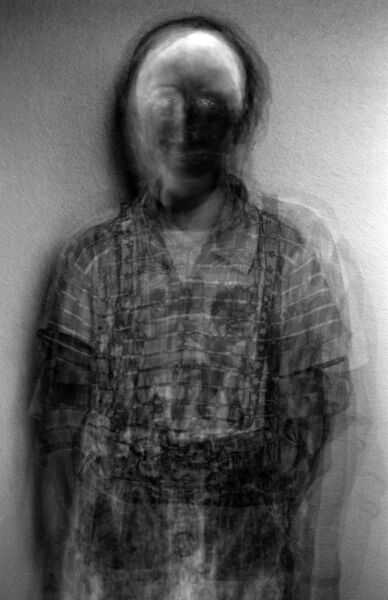
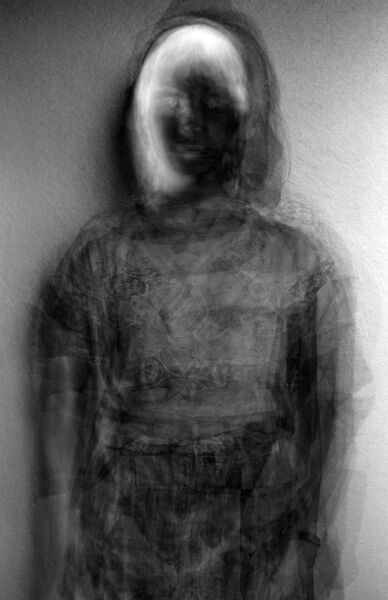
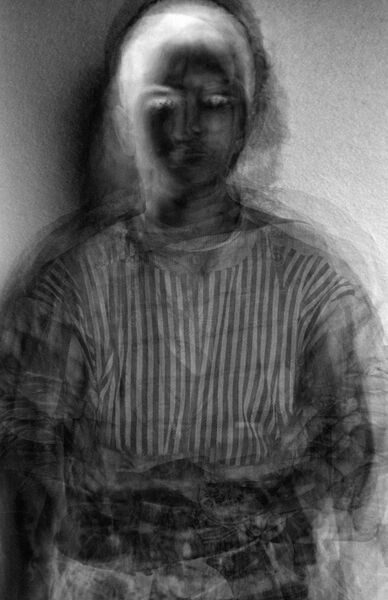
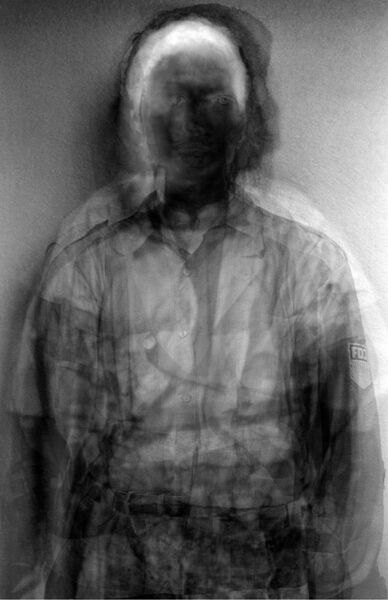
History Overwritten uses the same student portraits that form the basis of Pavlov’s Children and Faux Diamonds. I overlay multiple negatives of different portraits, then solarise and invert the resulting images. Individual faces gradually dissolve into dense, abstracted forms.
The original photographs remain within the layered image, but they can no longer be encountered individually. One portrait merges with another, creating a visual accumulation in which recognition becomes unstable. The process shifts the photographs from individual records towards something collective and less defined.
Here, transformation takes place through repetition, superimposition and the loss of a fixed point of view. The original portraits are neither erased nor simply preserved. They remain as traces within a new image, their visibility dependent on how the layers interact.
The work forms part of an ongoing engagement with the same photographic material. Rather than producing a new source image, I return to the existing negatives and photographs and ask how far they can be transformed while still retaining their presence. Each process produces a different condition of visibility: in Pavlov’s Children the negatives are enclosed, in Faux Diamonds they become physical objects, while in History Overwritten they merge into one another.
The historical context of the portraits remains important, but the work is driven by the material question of what happens when an existing image is altered, layered and revisited. What remains recognisable, what disappears, and what emerges through the transformation becomes part of the work itself.
12 prints in series, 80 × 60 cm each
The original photographs remain within the layered image, but they can no longer be encountered individually. One portrait merges with another, creating a visual accumulation in which recognition becomes unstable. The process shifts the photographs from individual records towards something collective and less defined.
Here, transformation takes place through repetition, superimposition and the loss of a fixed point of view. The original portraits are neither erased nor simply preserved. They remain as traces within a new image, their visibility dependent on how the layers interact.
The work forms part of an ongoing engagement with the same photographic material. Rather than producing a new source image, I return to the existing negatives and photographs and ask how far they can be transformed while still retaining their presence. Each process produces a different condition of visibility: in Pavlov’s Children the negatives are enclosed, in Faux Diamonds they become physical objects, while in History Overwritten they merge into one another.
The historical context of the portraits remains important, but the work is driven by the material question of what happens when an existing image is altered, layered and revisited. What remains recognisable, what disappears, and what emerges through the transformation becomes part of the work itself.
12 prints in series, 80 × 60 cm each